

Most people think impact grows with seniority. We’ve been conditioned to believe that the bigger the title, the larger the influence. Over time, this belief becomes accepted as truth. Promotions feel like proof. Titles feel like validation.
Project Aristotle quietly disproved that idea.
This landmark study analyzed hundreds of teams across Google. These teams varied widely in scope, size, and responsibility. The researchers compared team composition, education, tenure, personality types, and technical skill. They looked for the “magic formula” that could explain why some teams consistently performed better than others.
None of those factors reliably predicted success.
The strongest teams did not have the smartest people. They did not have the most experience. They were not stacked with top performers or built around a single star. They had something else: consistent behaviors.
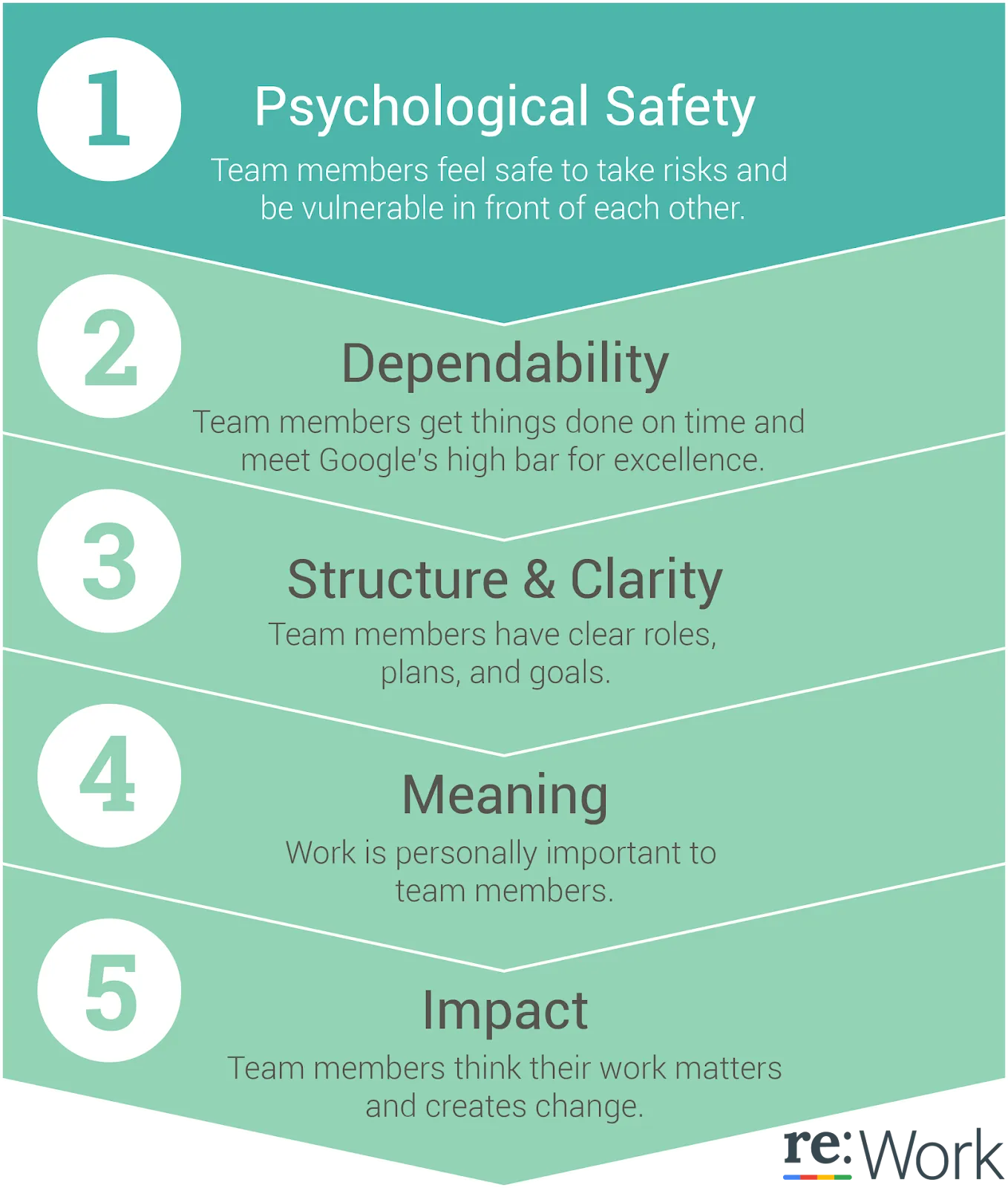
This is where the research becomes useful at an individual level. Impact is less about who you are and more about how you show up. Behaviors show up every day—in meetings, in documents, in decisions, and in follow-through. Let’s look at these five behaviors to see where you are on track and where you need to improve.
1. The Foundation: Psychological Safety
This is the non-negotiable engine of impact. Project Aristotle found that without safety, the other behaviors on this list cannot survive. It is not a policy or a value written on a slide; it is experienced in moments. It shows up in how ideas are received and how mistakes are handled.
You build psychological safety when you:
Share early thinking instead of waiting for perfection.
Ask questions that surface confusion.
Admit mistakes quickly and explain what you learned.
Respond to ideas with curiosity, even when you disagree.
Invite quieter voices and acknowledge their input.
2. Dependability
Dependability is about whether others can rely on your work without adding “management overhead.” This behavior compounds over time. Each delivery adds to your track record; each missed commitment subtracts from it. You demonstrate it when you:
Deliver work on time and at the expected quality.
Communicate progress before someone has to ask.
Flag risks early rather than at the deadline.
Follow through on small commitments and action items.
3. Structure and Clarity
Structure and clarity reduce confusion and rework. They help teams move faster with fewer misunderstandings. This behavior often goes unnoticed when it is done well, but when it is missing, everyone feels it. You create clarity when you:
Restate goals and success criteria in writing.
Break work into clear steps with ownership.
Confirm expectations before starting deep work.
Use shared documents to make plans visible.
Align daily tasks to team goals.
4. Meaning
Meaning is personal and can come from different places. When meaning is present, work feels connected. When it is absent, work feels mechanical. What matters is that you understand it and bring it into how you work. You bring meaning when you:
Understand what motivates you personally.
Explain why a task matters, not just what to do.
Choose approaches that reflect your values.
Help teammates see the bigger picture.
5. Making Impact Visible
Visibility isn’t about bragging; it’s about alignment. If the organization doesn’t see the result, the impact hasn’t fully landed. You make impact visible when you:
Share outcomes, not just activity.
Explain what changed because of your work.
Identify who benefited and why.
Tie results to team or organizational goals.
Document achievements for future reference.
The “Monday Morning” Audit
These behaviors are visible. Others experience them directly when they work with you. To get a real pulse check, consider adding questions from these five behaviors to your next 360-degree feedback. Don’t just ask if you are “doing a good job.” Ask: Do I demonstrate psychological safety in meetings? Do I bring clarity and structure to discussions?
But don’t wait for a formal review. Tomorrow morning, pick one “early thinking” idea—something unpolished and raw—and share it with your team. Ask for their input before you’ve made it perfect. This single act builds safety, creates clarity, and invites others into the meaning of the work.
Your influence doesn’t start with a promotion. It starts with how you show up tomorrow.