

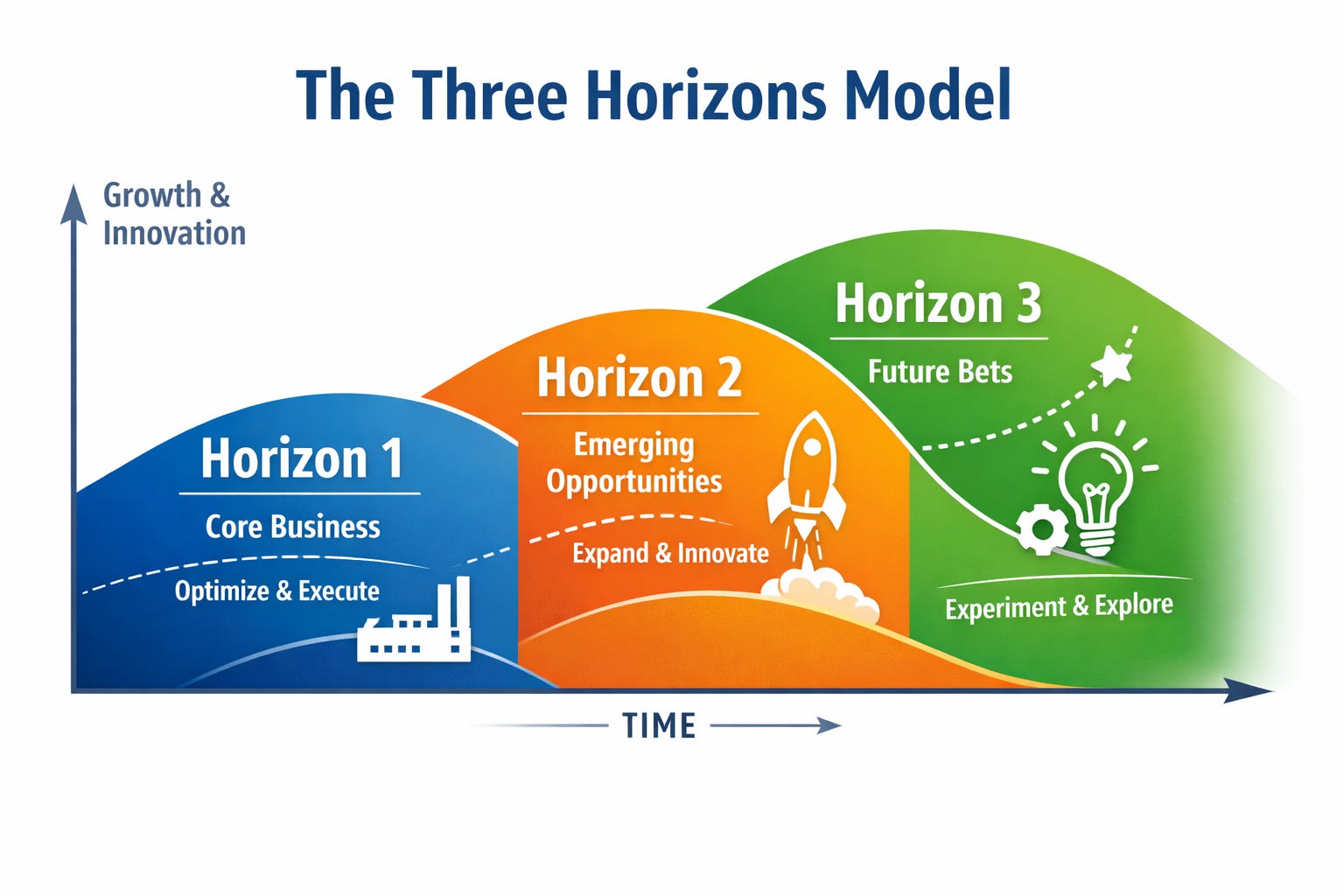
McKinsey introduced the Three Horizons framework to help companies think about growth over time, without neglecting the present or betting everything on an uncertain future.
The idea is simple.
Horizon 1
Horizon 1 represents the core business today.
This is where most revenue, customers, and execution live. The focus is on optimization, efficiency, and reliability. Companies depend on Horizon 1 to survive.
Horizon 2
Horizon 2 represents emerging opportunities.
These are adjacencies to the core business. New products, new markets, or new capabilities that are starting to show traction but are not yet fully proven. This horizon requires learning, experimentation, and patience.
Horizon 3
Horizon 3 represents future bets.
These are experiments and ideas that may not generate revenue today, but could become meaningful businesses in the future. High uncertainty and long timelines are the norm here.
The discipline of the model is not choosing one horizon over the others. It is investing in all three at the same time, with different expectations and metrics.
How Companies Use It in Practice
Consider a company like Amazon.
Horizon 1 is the retail and marketplace business. It is mature, operationally intensive, and measured against execution metrics such as cost, speed, and reliability. This business pays the bills.
Horizon 2 was Amazon Web Services in its early years. It started as an internal capability and later became a customer-facing product. It required different talent, different incentives, and a high tolerance for uncertainty. At the time, it did not look like the company's obvious future.
Horizon 3 includes bets like autonomous delivery, healthcare, and new AI-driven services. These teams often operate with small budgets, high learning velocity, and very little immediate financial pressure to perform.
What makes Amazon effective is not that it always picks the right bets. It intentionally funds all three horizons at the same time.
Using the Three Horizons to Think About Your Career
Once you start seeing your career through this lens, a few things become clearer.
Your current job is Horizon 1.
Your stretch projects and adjacent skills are Horizon 2.
Your experiments, learning, and optional bets are Horizon 3.
The problem is not that people spend time in Horizon 1. The problem is when they spend all their time there without realizing it.
Here are five practical ways to use this framework in your own career planning.
1. Map your current work to the three horizons
Take an honest look at how you spend your time. Which parts of your job are pure execution? Which parts involve learning something new or working in ambiguity? Which parts, if any, are long-term bets? Most people have never done this exercise.
2. If 100 percent of your work is Horizon 1, it is time to explore
That does not mean changing jobs immediately. It means starting a conversation. This is an excellent topic for your next meeting with your manager. Often, there are opportunities within the same team that expose you to Horizon 2 or even small Horizon 3 efforts.
3. Look beyond your team for Horizon 2 and 3 exposure
Some of the best learning happens through collaboration. Keep an eye out for cross-team projects, pilot initiatives, or problems that need help. These are often under-resourced and welcome contributors who are curious and reliable.
4. Assess whether your skills match uncertainty
Horizon 2 and 3 work requires different skills from Horizon 1. Comfort with ambiguity, learning speed, communication, and influence matter more than deep specialization alone. If these skills feel weak, that is your signal, not your stop sign.
5. Remember that staying in Horizon 1 is a valid choice
There is nothing wrong with thriving in Horizon 1 roles and companies. Many people love that work and do it exceptionally well. Some of my coaching clients have spent 20 years in Horizon 1 roles and built strong, fulfilling careers. A few of them are now choosing to move into Horizon 2 or 3 later in life. Age is just a number. With a growth mindset and the ability to learn, movement across horizons is always possible.