

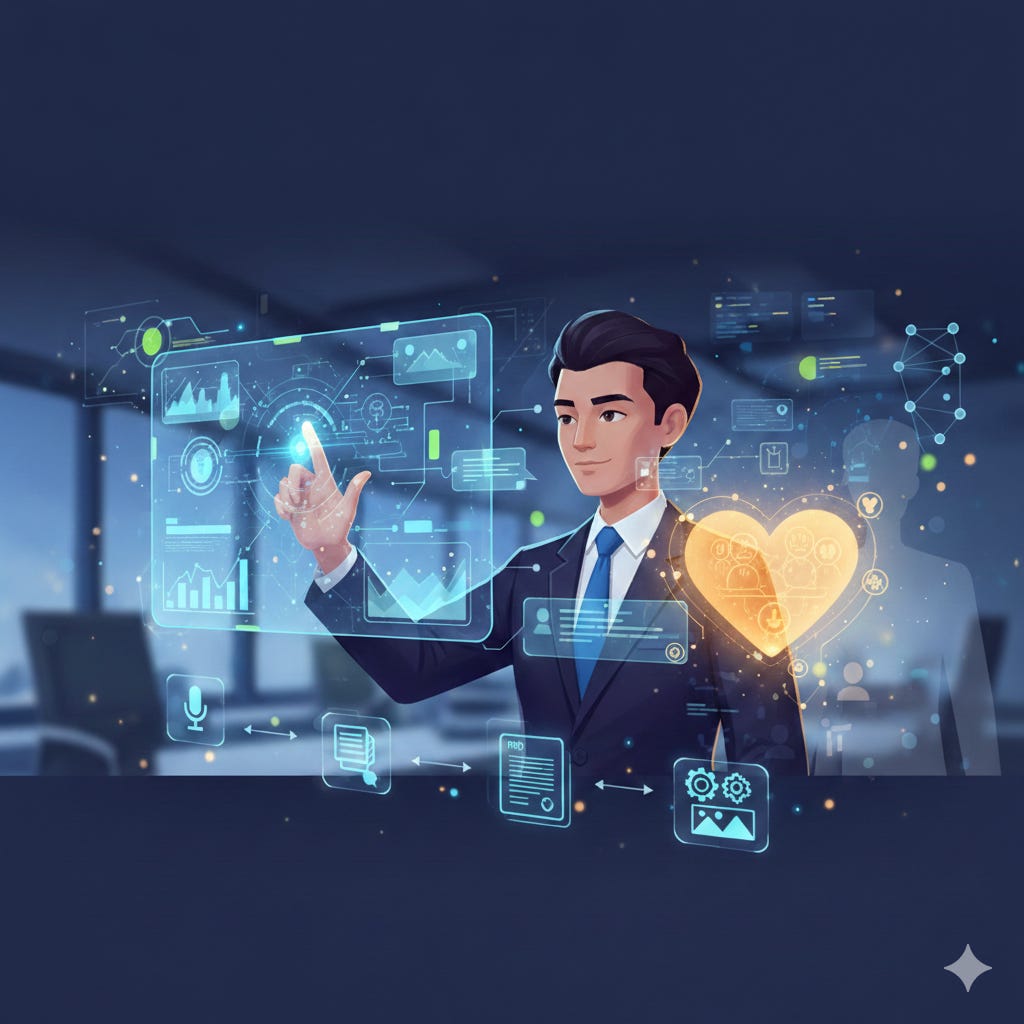
For 16 years of my career, my identity was defined by managing teams. I focused on people, organizational structures, and the art of delivery through others. It was rewarding, but it often meant being several layers removed from the actual “building.” Now, I am back as an individual contributor (IC) at Google, and I have to tell you: it is fascinating to see how productive I can be today.
The secret isn’t just my years of experience; it’s the profound shift in how I work. In this new era, I never have to start with a blank page. I partner with AI to create, iterate, and build. What used to be hours of mundane, soul-crushing tasks now takes a few minutes. This leverage allows one person to do the work that used to require a small squad.
Here is exactly how I am using AI in my daily life as a Product Manager to automate the “work about work” and focus on building great products:
Never Missing a Beat in Meetings: I record every single meeting and take comprehensive notes. But the real magic happens afterward. I convert those transcripts into a question-and-answer format. This creates a searchable, future-proof reference that captures the why behind a decision, not just the what. If a stakeholder asks months later why we chose a specific path, I have the exact answer at my fingertips in seconds.
Conversational PRDs: Writing a Product Requirements Document (PRD) used to be a lonely, grueling process. Now, I discuss the requirements out loud in a natural conversation. I take that transcript and let AI convert it into a structured draft. It’s much easier to edit a strong, 80% finished draft than to conjure one from thin air.
Visualizing Complexity: I use AI to generate custom images for my slides and complex flow diagrams. It allows me to visually communicate architectural shifts or user journeys. This resonates with leadership much more than a wall of text ever could.
My Personal Think-Tank with NotebookLM: This has been a total game-changer for my workflow. I upload all my context files—research, docs, and feedback—into NotebookLM. I then listen to the generated “Deep Dive” podcast, in which two hosts discuss my specific documents. It helps me hear my own project from a third-party perspective, often revealing gaps I missed. I also use the features to create infographics and quizzes to test my own understanding of deep technical stacks.
Analyzing 100,000 Rows in Minutes: Recently, I had to find patterns in a spreadsheet with 100,000 rows. Through exploratory data analysis with AI, I identified the signal in the noise and summarized those insights into a single, one-page brief for my leadership team.
The Power of the “Show, Don’t Tell” Demo: I used AI Studio to create a mock demo web app. Instead of just talking about how we could simplify collecting user company and address information, I built a functional demo of an autocomplete feature. Showing this to other PMs and UX designers was infinitely more powerful than a slide deck; they could see exactly how we improved the user experience in real time.
As AI continues to improve in its computing and creating power, I’ve realized something important. The more the “machine” part of the job is automated, the more the “human” part matters.
The only thing we can truly do to stay ahead is to improve our EI—our Emotional Intelligence. Our ability to collaborate, connect deeply, empathize, and show compassion to the people around us is the only thing that cannot be automated. I am using AI to handle the mundane so I can focus on being human. That is the path of the high-impact IC.
Micro-Sharing Challenge
Identify one recurring meeting this week where you usually struggle to capture all the details. Use an AI tool to record and summarize it into a Q&A format. Share that summary with the attendees and see if it changes the way your team tracks follow-ups.