

The Johari Window is a framework for understanding self-awareness and human interaction through what is known and unknown about a person. Created by psychologists Joseph Luft and Harrington Ingham, it divides awareness into four interrelated areas.
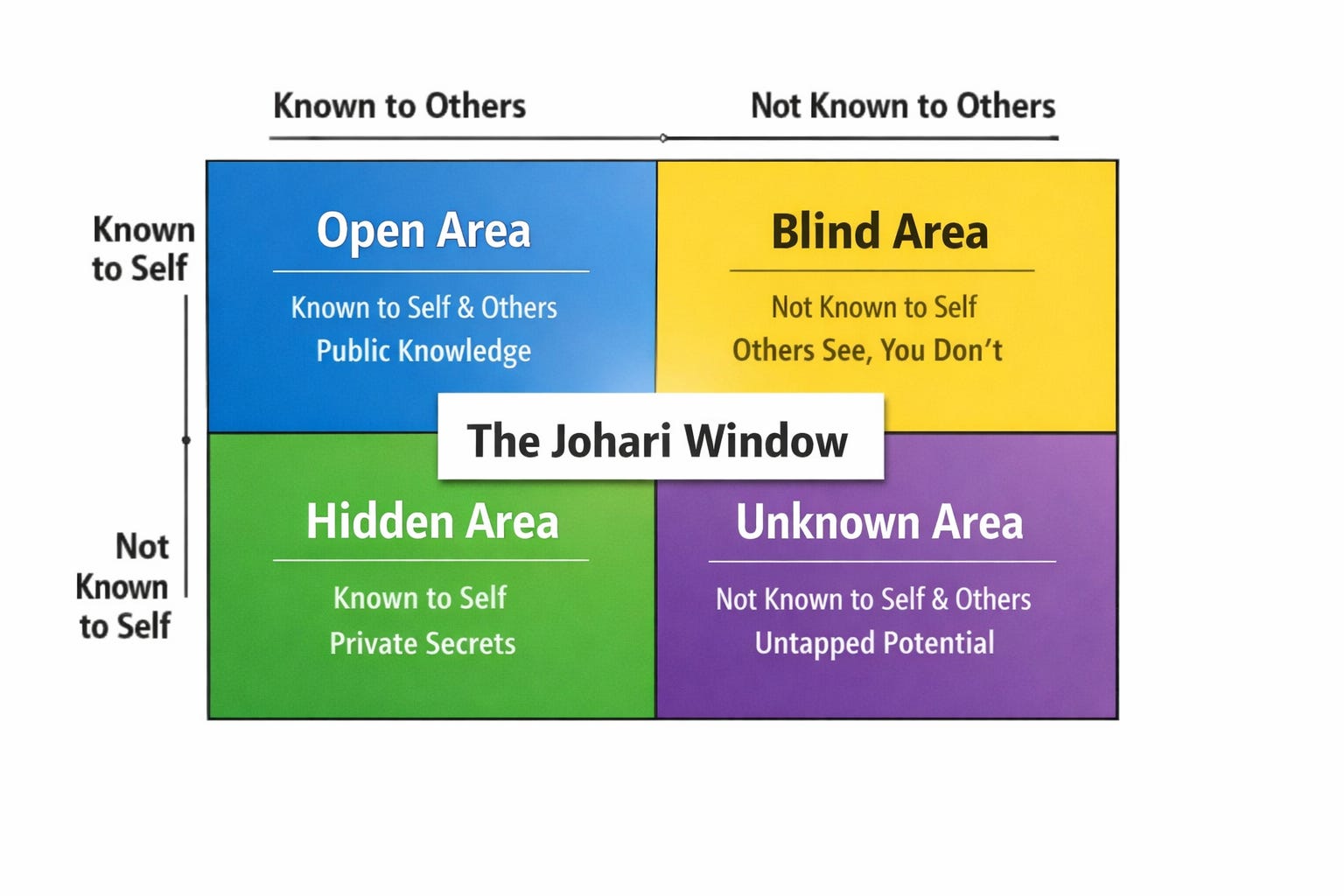
Open Area
What is known to you and visible to others. This includes behaviors, skills, and attitudes that are openly expressed and understood in relationships.
Blind Area
What others notice about you that you do not. These are patterns, habits, or impacts that surface through honest feedback.
Hidden Area
What you know about yourself but choose not to share. This includes private thoughts, fears, and personal experiences.
Unknown Area
What is not yet known to you or others. This includes untapped potential, unconscious responses, and abilities revealed through new situations.
How I First Encountered the Blind Area
I first learned about the Johari Window during a coaching program in my first year as a manager in 2008. The blind area immediately stood out to me.
Around the same time, I was reading Dr. Marshall Goldsmith’s book What Got You Here Won’t Get You There, which reinforced the importance of understanding how others experience our behavior. Inspired by this, I ran an anonymous 360-degree feedback survey for the first time in my career to learn how my colleagues and team members perceived my leadership behaviors.
The exercise proved extremely valuable. I gained insight into blind spots I had not been aware of and realized that certain behaviors, despite good intentions, were perceived as unhelpful. This experience made it clear that leadership effectiveness is shaped by perception as much as intent.
Why This Matters Earlier Than We Think
Knowing how people perceive you and adjusting your behavior are essential steps in a leadership journey. This kind of deliberate effort is often associated with senior leaders.
In my view, individual contributors benefit even more when they understand this intention–perception gap early in their careers. Growth slows when blind spots remain unaddressed. Technical expertise alone does not help in handling disagreements with stakeholders or working across cross-functional teams.
Hiring an executive coach is not realistic for everyone. To address this challenge, I adapted Dr. Goldsmith’s leadership development approach into a simple, practical process. I strongly encourage you to read What Got You Here Won’t Get You There for a deeper understanding of behavioral coaching and sustained change.
A Simple Process to Reduce Your Blind Spots
1. Identify your key stakeholders at work
Include team members, your manager, peers from other teams, stakeholders, and customers with whom you interact frequently. Limit the group to six to ten people to ensure meaningful feedback. Avoid selecting only people who are close to you.
2. Create a simple feedback survey
Use a Google Form with two questions:
What am I doing well in my role?
What could I improve?
3. Set clear expectations for participation
Communicate that the survey is anonymous and that honest feedback is encouraged. Allow three to five days for responses. Do not follow up if someone chooses not to participate.
4. Involve your manager when appropriate
This helps stakeholders understand the purpose of the exercise. Make it clear that the feedback is visible only to you.
5. Review feedback for patterns
Look for recurring themes in how people perceive you. Avoid focusing too much on isolated comments, as they can distract from the core insights.
6. Consider a coach if needed
If the process feels overwhelming, working with a leadership coach can help you make better sense of the feedback and translate it into action.
7. Choose one or two behaviors to change
Focus on a small number of behaviors in each cycle and take deliberate steps to demonstrate change in your day-to-day interactions.
8. Practice regular feedforward conversations
Meet with stakeholders monthly for five to ten minutes to thank them, share what you are working on, and ask how they can support you. Dr. Goldsmith refers to this practice as feedforward.
9. Run a progress check every six months
Ask stakeholders to rate your effort to change and the effectiveness of those changes in their interactions with you.
10. Repeat the cycle every twelve to eighteen months
Use each cycle to refine different aspects of your leadership and continue smoothing rough edges in interpersonal interactions.